
 Drone Services
 Access Equipment
 Breaking & Drilling
 Cleaning Equipment
 Drying & Heating
 General Site Tools
Equipment Hire Guides
Mop or Machine: What Should Clean a Warehouse Floor?
Quick answer
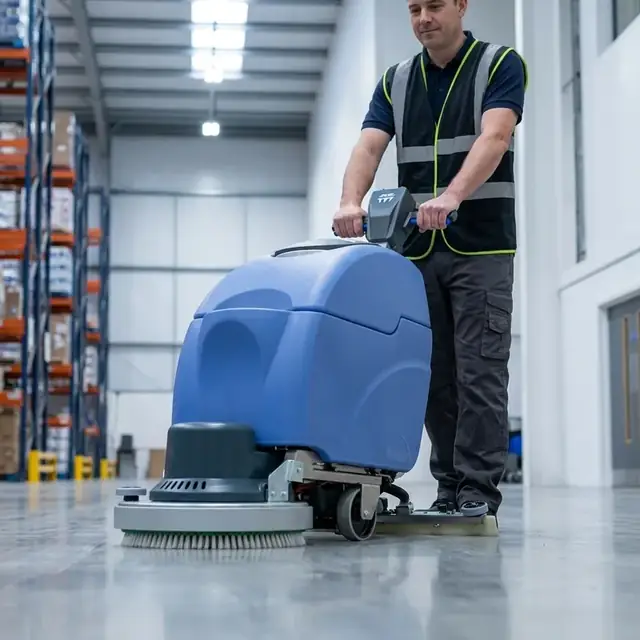
One question decides it: can the floor be wet for 20 to 30 minutes? If not, because forklifts are running and staff are walking, you need a scrubber dryer, which washes and vacuums in one pass. If it can, a rotary scrubber is more versatile because it also strips and polishes.
Key takeaways
- Mops run out of road. Once the bucket is dirtier than the floor, you are spreading soil, not removing it.
- Wet floors are a hazard. In an operational warehouse, that is what makes the scrubber dryer the only sensible option.
- Plan the transport. The scrubber dryer is 57kg dry and 1,150mm long.
- Sweep first. These machines are not sweepers.
| Can the floor be wet for 20 to 30 minutes? | Machine | Result |
|---|---|---|
| No. Operational area, forklifts, staff moving | Scrubber dryer | Dry and walkable behind the machine |
| Yes. Out of hours, closed area, weekend | Rotary scrubber | Also strips and polishes, but leaves the floor wet |
| Spot cleaning, spills, under 50 square metres | Mop | Setup time outweighs the saving |
| Behind racking legs, fixed benching | Mop | A machine cannot reach |
Why does mopping stop working on a big floor?
A mop and bucket works by putting clean water on the floor and taking dirty water off. In a domestic kitchen that is a reasonable exchange, because the floor area is small relative to the volume of water in the bucket.
On a warehouse floor the arithmetic collapses. By the third or fourth dunk, the water in the bucket is dirtier than the floor.
What does the scrubber dryer actually give you?
The Numatic TwinTec TT 3450S is a walk-behind machine that washes and dries in one pass, so the floor is walkable straight behind you.
Two of its numbers deserve comment. 42 metres of cable reach from a standard 13A socket is what makes it practical in a warehouse, where sockets are scarce and spaced for racking rather than cleaning. 57kg dry and 1,150mm long decides your transport.
Read more: why the 450mm deck is the right width
When is the rotary scrubber the better choice?
The rotary floor scrubber and buffer is a Numatic BMD 1000 series machine with a 450mm disc, running on 230V with an RCD included.
A rotary is a single rotating disc that takes different pads and brushes. It scrubs, polishes and buffs, which makes it more versatile, but it does not pick the water up. It is the right choice when:
- The area can be closed off while it dries
- The floor needs aggressive agitation rather than routine washing
- You are doing a strip and reseal
- You also need to polish or buff afterwards
When is a mop still the right answer?
Being honest about this matters more than selling a machine. A mop remains sensible for:
- Spot cleaning and spills
- Small offices, welfare areas, kitchens and toilets, under roughly 50 square metres
- Areas a machine cannot reach, such as behind racking legs and in corners
- Floors that should not be flooded, including some timber and some unsealed surfaces
What do I need to sort before delivery?
- Sweep or vacuum first. Loose debris, pallet wrap and cardboard will block the recovery path and damage the squeegee
- Identify the floor type. These machines are for indoor hard floors: sealed concrete, resin, vinyl and tile
- Find your sockets. 42 metres is generous, but map the route
- Plan the water. You need a fill point and a suitable disposal point
- Plan the transport. 57kg and 1,150mm long
- Check clearances. Aisle widths, the route from the loading bay, and thresholds
What will a machine not fix?
- Tyre marking from forklifts is rubber deposited into the floor surface. The right pad improves it considerably, but it does not always remove it
- Oil soaked into unsealed concrete is below the surface
- A failed floor coating needs recoating, not cleaning
- Chemical staining may be permanent
Frequently asked questions
Is mopping a warehouse floor actually a problem?
What is the difference between a rotary scrubber and a scrubber dryer?
Does the scrubber dryer need a special power supply?
How heavy is it, and can I collect it in a car?
Will it fit down my aisles?
Will it remove forklift tyre marks?
The Hireload team runs the hire fleet from our Greenford depot in west London and handles the delivery calls.
Related guidance
- How to clean a warehouse floor
- Floor scrubber vs mop
- What is a floor scrubber dryer used for?
- Which cleaning equipment do I need?
Specifications were verified from our live product pages and may vary by the unit supplied. These machines are for indoor hard floors; confirm suitability for your specific floor finish. Disposal of floor washings from industrial premises may be subject to local trade effluent conditions. This is general guidance, not professional advice.

 Drone Survey & Mapping
 Drone Inspections