
 Drone Services
 Access Equipment

 Breaking & Drilling
 Cleaning Equipment
 Drying & Heating
 General Site Tools
Equipment Hire Guides
Can I Clean My Rug With a Hired Carpet Machine?
Quick answer
On most synthetic rugs, yes, using a hired carpet machine with less solution and far more dry passes than on a fitted carpet. On wool, viscose, silk, jute or hand-knotted rugs, wet extraction risks shrinkage, browning or permanent texture damage. There is no dedicated rug machine in hire, so you use a carpet extractor on the rug.
Key takeaways
- The fibre decides it, not the machine. Check what the rug is made of first.
- Viscose catches people out. Water alone can leave permanent yellow-brown marks.
- Less water, more extraction. A rug has no subfloor to absorb into.
- Dry it flat with air on both sides. Never hang a wet rug over a bannister.

| Rug fibre | Wet extraction at home | Note |
|---|---|---|
| Polypropylene, polyester, nylon | Generally suitable | Most modern machine-made rugs |
| Wool | Caution | Can shrink, and shrinkage is permanent |
| Viscose, rayon, bamboo silk, art silk | Not advised | Water alone can leave yellow-brown staining |
| Jute, sisal, seagrass | Not advised | Plant fibres, not for wet cleaning |
| Silk, hand-knotted, antique | Specialist only | Off-site immersion and controlled drying |
How do I tell what my rug is made of?
This is the whole decision. Viscose, sometimes sold as art silk, bamboo silk or rayon, has a bright sheen and feels cool and slippery. It also darkens and stiffens noticeably when a small area is damped.
Read more: when uncertainty is itself the answer
If you do not know what the rug is made of, and it was expensive or inherited, that uncertainty is the answer. Take it to a rug specialist.
Wool can clean well in professional hands but is sensitive to over-wetting, heat and high-alkaline chemistry. Silk and hand-knotted oriental or Persian rugs usually need specialist cleaning, often off-site, with full immersion and controlled drying. The value at risk is rarely worth the saving.
What two tests should I do first?
- Colourfastness. Damp a white cloth with your cleaning solution, press it firmly onto an inconspicuous part of the pile for a few seconds, and look at the cloth. Any colour transfer at all means stop.
- The backing. Turn the rug over. A jute or hessian backing under a synthetic pile is common, and jute can release brown colour into the pile when wet. A rubber or latex backing can break down with heat and over-wetting.
Which machine should I use on a rug?
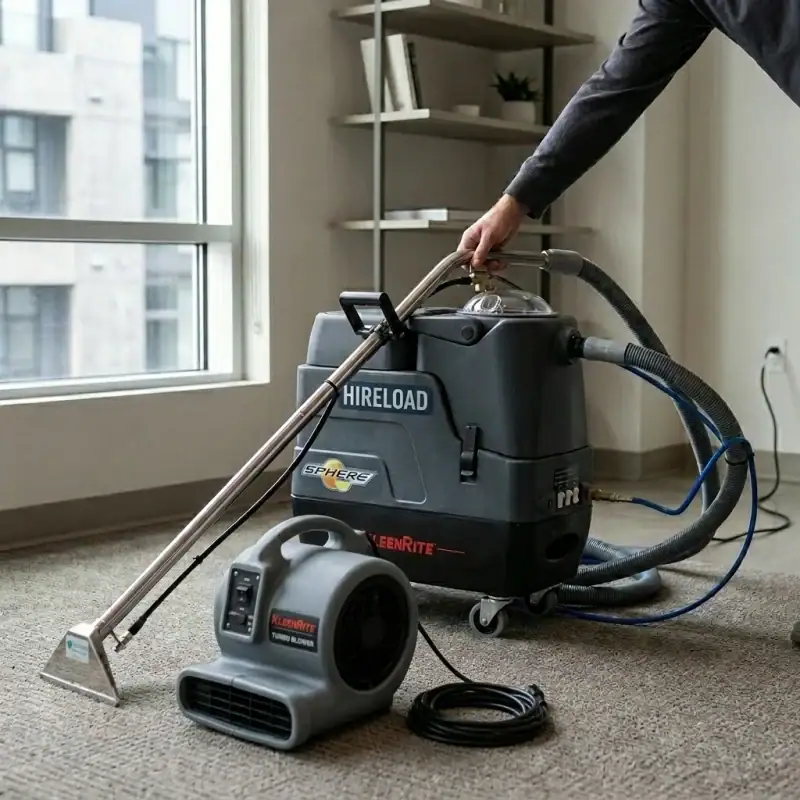
For most households the KleenRite SPHERE is the machine to start with, because the heated water lifts greasy soiling and the upholstery tool handles borders and edges. Two lower-water alternatives are worth a look for synthetic rugs.
| Machine | Suits |
|---|---|
| Numatic CTD570-2 | Synthetic rugs, lower water volume |
| Truvox brush-type cleaner | Synthetic rugs with ground-in soil |
| KleenRite SPHERE | Greasy soiling; upholstery tool useful on borders |
What is the right method on a rug?
- Vacuum both sides. Turn it over and vacuum the back; you will be surprised what comes out.
- Test colourfastness and let the patch dry.
- Work on a hard floor, not on carpet. Moisture and bleeding dye transfer straight into the carpet underneath.
- Go light on solution. One wet pass, then three or more dry passes.
- Work with the pile direction.
- Stay off the fringe with the machine, as fringes tangle and discolour.
- Dry flat and fast.
Read more: how to run the passes
Start at the far end of the rug and work back towards the door so you never stand on cleaned pile. Make the wet pass slowly in one direction, then make the dry passes with the trigger released so the machine is only extracting. Keep going until the water coming into the recovery hose is close to clear.
Empty the recovery tank as often as it needs; a full tank stops extracting and leaves water behind in the rug.
Why is drying a rug different from drying a carpet?
A fitted carpet dries from the top with air moving across it. A rug is a sandwich with no ventilation underneath, and if the back stays wet you can get odour and, on some constructions, browning that migrates up into the pile.
- Never hang a wet rug over a bannister or line. The weight of the water can distort the weave, and it may stay distorted.
- Dry it flat, ideally raised on blocks or slats so air reaches both faces.
- Get air moving. An air mover aimed along the rug, not down onto it.
- In a closed room, add a dehumidifier.
- Do not put furniture back until the backing is dry.
When should I pay a specialist instead?
Be realistic about the arithmetic. Hire and consumables for a weekend are modest. A hand-knotted rug is not, and a viscose rug that has gone yellow and matted usually cannot be put back.
Frequently asked questions
Can I use a carpet cleaner on a rug?
How do I know if my rug is viscose?
Should I clean the fringe?
Can I clean a rug on top of my carpet?
How long does a rug take to dry?
Will it get rid of pet smells?
The Hireload team runs the hire fleet from our Greenford depot in west London and handles the delivery calls.
Hire the right machine for the rug
Commercial hot water extraction with an upholstery tool, delivered across London.
Compare carpet and rug machines
Or call 020 3375 4048 and tell us the fibre
Related guidance
- How to use a carpet cleaner
- Carpet cleaner hire vs professional
- How to dry a wet carpet without ripping it up
- Will carpet cleaning kill moths?
General practical guidance based on common rug constructions, not professional advice. It is not a substitute for the rug manufacturer’s own care instructions. For silk, viscose, hand-knotted, antique or high-value rugs, consult a specialist rug cleaner before any wet cleaning. Hireload cannot assess your rug remotely.

 Drone Survey & Mapping
 Drone Inspections