
 Drone Services
 Access Equipment
 Breaking & Drilling
 Cleaning Equipment
 Drying & Heating
 General Site Tools
Equipment Hire Guides
Does a 43L Dehumidifier Really Remove 43 Litres a Day?
Quick answer
No, not in your room. The litre figure is measured at 30°C and 80% relative humidity. In a typical 20°C room the same machine removes around half that. Every manufacturer rates this way, so the number is a fair comparison between machines but not a promise about your room.
Key takeaways
- Expect roughly half the headline figure in a normal heated room, and less in a cold one.
- Access beats capacity in London. A heavy machine that cannot reach the wet room removes nothing.
- A slowing tank usually means progress, not a fault. The room is drying.
- In a cold space, add heat or consider an LGR machine rather than simply going bigger.
| Your space | Machine | Why | Fit |
|---|---|---|---|
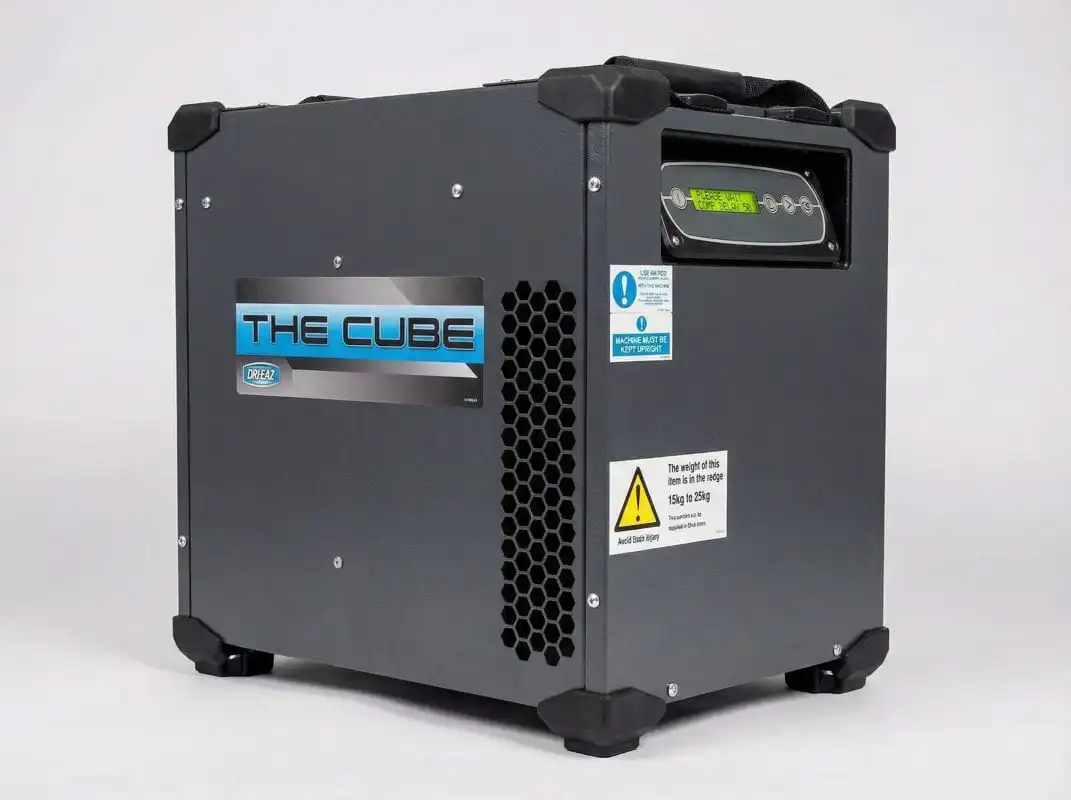
| Flat, upstairs room, tight plant room | Cube 43L | 22.7 kg with carry handles, built-in pump-out | Good fit |
| Larger open area, ground floor | 55L DrizAir 1200 | More capacity, 36 kg on wheels | Good fit |
| Single room condensation | 20L compact | Domestic class, rooms up to 50 m² | Depends |
| Unheated garage, lock-up, winter site | 63L LGR | Built to keep extracting as humidity drops | Depends |
What does the litre number actually measure?
A refrigerant dehumidifier draws air across a cold coil. Moisture condenses on the coil and runs off as water. The amount it extracts depends almost entirely on how much moisture the air is carrying, and how warm it is. For every size we stock, see our dehumidifier hire London page.
- Warm air holds more moisture. More moisture means more available to condense.
- Cold air holds very little. There is simply less to take out.
Read more: the figures on our own product page
Is a bigger number always a better machine?
If two machines are rated at the same conditions, the litre figure is a fair comparison of capacity. What it does not tell you is whether the machine suits your job.
| Cube 43L | 55L DrizAir 1200 | |
|---|---|---|
| Rated extraction | Up to 43 L/day | Up to 55 L/day |
| Weight | 22.7 kg, carry handles | 36 kg, moved on wheels |
| Drainage | Automatic pump-out, 6 m hose | Automatic pump-out, 12.2 m hose |
| Typical use | Flats, upstairs rooms, tight plant rooms | Larger open areas, ground floor |
When does the litre rating genuinely matter?
It is not a useless number. It matters when:
- The space is large. A warehouse or a whole floor needs capacity.
- The conditions are warm and wet. Straight after a flood in a heated building, the machine is closer to its test conditions.
- You are comparing like for like. Two refrigerant machines rated at the same conditions can be ranked.
Why does performance drop in a cold room?
Below a certain temperature a standard refrigerant dehumidifier struggles. As the room gets colder the coil gets colder, and at low enough temperatures it can ice up. The machine then spends its time defrosting rather than extracting.
Read more: why heat often beats a bigger machine
Why is the tank filling more slowly than I expected?
Three ordinary reasons, usually not a fault:
- The room is cooler than the test condition. Around half the rated output at 20°C is normal.
- The room is drying. As humidity falls there is less moisture to collect, so collection slows. A slowing tank is usually evidence the machine is working.
- Doors and windows are open. A dehumidifier works on the air in an enclosed space.
Frequently asked questions
Does a 43L dehumidifier really remove 43 litres a day?
Is a 55L machine always better than a 43L one?
Why is my dehumidifier collecting less water than yesterday?
Should I leave the door open so it dries the whole house?
What if the room is cold?
How do I know it is working at all?
The Hireload team runs the hire fleet from our Greenford depot in west London and handles the delivery calls.
Pick the machine that fits the room, not the biggest number
Tell us the space, the temperature and the floor it is on. We will tell you which unit suits.
Compare dehumidifier hireOr call 020 3375 4048 and describe the room
Related guidance
- What size dehumidifier do I need?
- How many dehumidifiers do I need?
- Dehumidifier not working in a cold room
- Heater vs dehumidifier for drying
General guidance, not professional advice. Performance figures come from our live product pages and are stated at the conditions given. Actual extraction depends on the temperature, humidity and volume of your specific space. Where drying forms part of an insurance claim or involves building structure, arrange a professional moisture assessment.

 Drone Survey & Mapping
 Drone Inspections