
 Drone Services
 Access Equipment

 Breaking & Drilling
 Cleaning Equipment
 Drying & Heating
 General Site Tools
Drying & Heating, Equipment Hire Guides
Budget vs Professional Dehumidifier: Which Dries Faster and Costs Less?
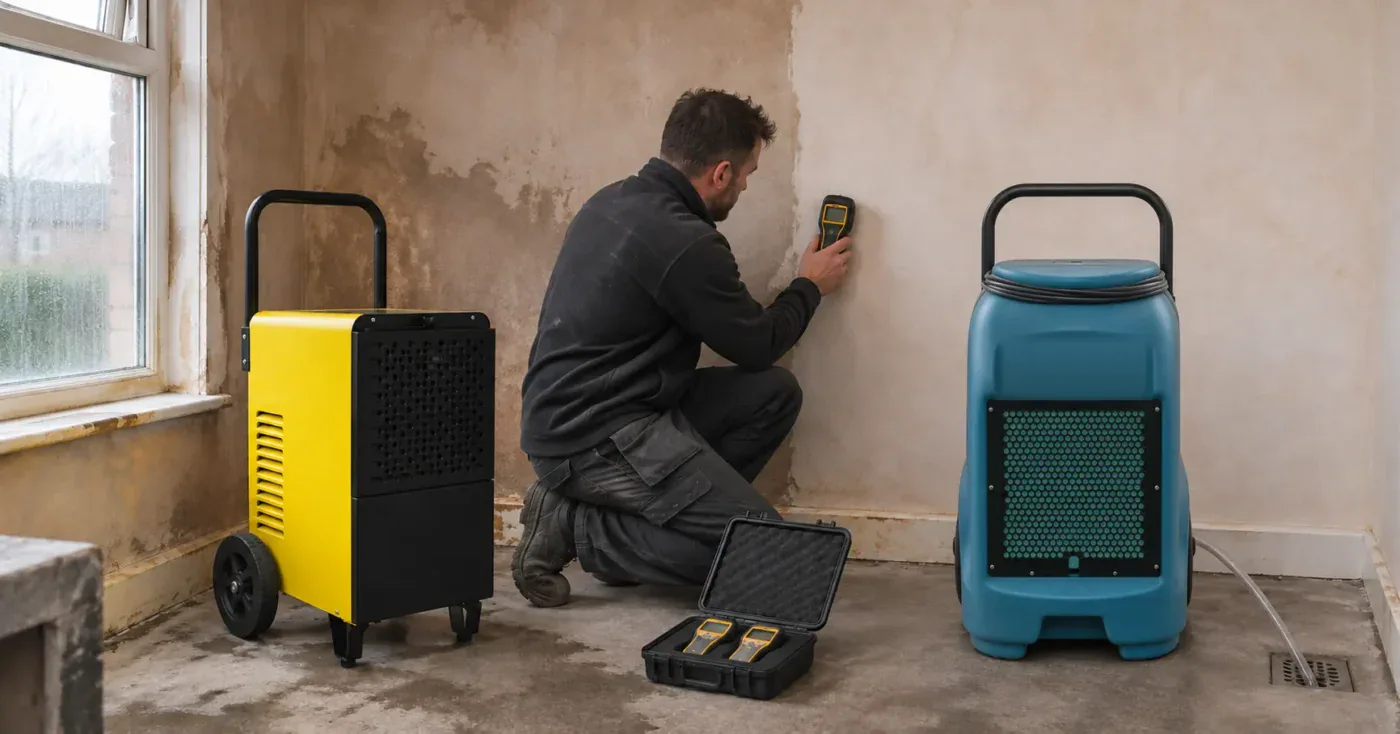
A cheap dehumidifier looks like a saving. Per litre of water removed, it rarely is.
Two machines can both say “20 litres a day” or “55 litres a day” on the box and still remove very different amounts of water from your room. A budget home dehumidifier is built for a warm bedroom and a bit of laundry. A professional unit is built to run for days on a leak, new plaster or a cold, empty property. This guide compares the two on the numbers that matter: water removed per day, electricity, hire cost per litre, and how long the job takes. It also says honestly when a budget unit is all you need.
Is a professional dehumidifier worth it over a budget one?
For leaks, new plaster, cold rooms and anything bigger than one heated bedroom, yes. A budget home unit sold as “20 L” removes about 8 litres a day in a 20 °C room and about 3 litres at 10 °C, according to one UK home-dehumidifier maker’s own tests. A professional 55 L unit removes about 28 litres a day at the 26.7 °C, 60% RH industry test point, is rated to run from 1 °C and pumps its own water away. In a warm room the two cost about the same per litre, but the professional unit finishes in roughly a third of the time. As the room cools, the budget unit falls further behind. Hireload hires professional units in London from £89.99 + VAT for up to 7 days, with 15% off on a trade account.
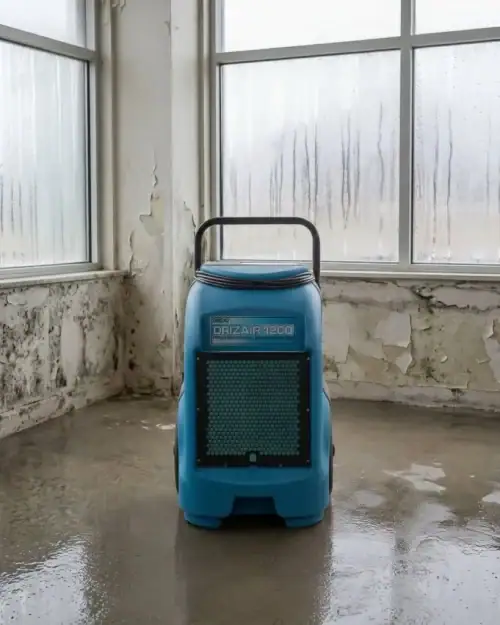
Why the number on the box is not what you get
Every dehumidifier is rated under test conditions, and different types are tested at very different conditions. Warm, very humid air gives up water easily, so a test in that air produces a big number. A normal UK room in winter is cooler and drier, and every refrigerant dehumidifier removes less there.
| Rating | Test air | Where you see it | What it tells you |
|---|---|---|---|
| Home “litres per day” | 30 °C, 80% RH | Budget and home units | Tropical conditions. Far more than a UK room gives |
| Room-condition figure | 20 °C, 60% RH | Rarely published | Close to a heated UK room, and much lower |
| AHAM rating | 26.7 °C, 60% RH | Professional units | The fairest figure for planning a job |
| Saturation maximum | 32.2 °C, 90% RH | Professional headline figure | What it pulls from very wet air at the start of a flood job |
So “55 L” on a professional unit and “20 L” on a home unit are both best-case figures. To compare fairly, compare at the same conditions.
Water removed per day, side by side
| Condition | Budget “20 L” home unit | Professional 55 L unit |
|---|---|---|
| Headline figure on the box | 20 L a day at 30 °C, 80% RH | 55 L a day at 32.2 °C, 90% RH |
| Warm room, about 26 °C, 60% RH | About 10 L a day (roughly half its headline figure) | About 28 L a day (AHAM rating) |
| Heated room, 20 °C, 60% RH | About 8 L a day | Less than at 26.7 °C, but built for these conditions |
| Cold room, 10 °C, 60% RH | About 3 L a day | Rated to keep working down to 1 °C |
| Power | About 7p an hour to run on average | 690 W, 3 A: about 18p an hour |
At the closest like-for-like point, the professional unit removes almost three times as much water a day. That is the difference between a room drying in a week and drying in three.
Cold rooms: where budget units stall
Most drying jobs happen in winter, in rooms where the heating is off or the walls are cold. That is where the gap between the two types is biggest.
Cost per litre: hire plus electricity
The fair way to compare is what each litre of water costs you to remove. These figures use our hire rates and the Ofgem price cap of 26.32p per kWh (October to December 2026). The budget unit’s power is taken as 7p an hour, the average running cost Which? reports for its Best Buy dehumidifiers. Many budget models use more.
| Machine and room | Litres a day | Electricity per litre | Hire + electricity per litre |
|---|---|---|---|
| Professional 55 L, about 26 °C | About 28 L | About 16p | About 62p |
| Budget “20 L”, about 26 °C | About 10 L | About 17p | About 62p |
| Budget “20 L”, 20 °C | About 8 L | About 21p | About 77p |
| Budget “20 L”, 10 °C | About 3 L | About 58p | About £2.13 |
Hire costs use £89.99 for 7 days for the professional unit (£12.86 a day) and £4.50 a day for a budget-class compact unit on a long hire. In a warm room the cost per litre is about the same. In a normal or cold room, the budget unit’s cost per litre climbs fast, and the job takes much longer.
A 200-litre drying job, worked out
Say a leak has left about 200 litres of water to take out of the air and materials of a room. This is an example to show the maths, not a prediction for your job.
| Machine | Days | Hire | Electricity | Total |
|---|---|---|---|---|
| Professional 55 L, warm room | About 7 | £89.99 | £30.51 | £120.50 |
| Budget “20 L”, warm room | About 20 | £90.00 | £33.60 | £123.60 |
| Budget “20 L”, 20 °C room | About 25 | £112.50 | £42.00 | £154.50 |
| Budget “20 L”, 10 °C room | About 69 | Not a practical way to dry the room | ||
Even where the bill comes out close, the professional unit gives you the room back about two weeks sooner. In a cooler room it is cheaper and much faster. For a single price that already includes an air mover, see our drying packages compared.
The costs that are not on the bill
Every extra week is a week a tenant, a shop, an office or your own family cannot use the space.
Flooring, decorating and kitchen fitting cannot start until walls and floors are dry. Delays push every booking back.
The longer plaster, timber and carpet stay damp, the more chance of mould, odour and damage to finishes.
Home units fill a small tank that stops the machine when full. The professional unit pumps water up to 12 m away through its hose, including 5 m uphill, so it runs day and night.
Built for different jobs
| Feature | Budget home unit | Professional unit |
|---|---|---|
| Made for | A warm bedroom, laundry, light condensation | Leaks, new plaster, flood drying, building sites |
| Best temperature | Works best at about 15 °C or warmer | Rated from 1 °C to 38 °C |
| Water handling | Small tank to empty by hand, sometimes a gravity hose | Automatic pump and 12.2 m hose |
| Defrost | Stops drying while the ice melts | Hot-gas defrost, back to work quickly |
| Case | Light plastic for a living room | Tough moulded case on wheels for sites and stairs |
| Running | Hours at a time | Built to run 24/7 for days or weeks |
When a budget unit is the right choice
A budget unit is not a bad machine. It is the wrong tool for a big job. It is a sensible choice when:
For that kind of job, a compact home-size unit is enough. For anything wet, cold or large, hire professional.
Which professional unit to hire
| Job | Unit | From (ex VAT) |
|---|---|---|
| A leak, new plaster or a damp room in a flat or house | 55 L professional dehumidifier | £89.99 for up to 7 days |
| Several rooms, late-stage drying, cooler spaces | 63 L LGR building dryer | £119.99 for up to 7 days |
| Whole floors, flood drying, new builds, large commercial spaces | 95 L LGR building dryer | £149.99 for up to 7 days |
LGR (low grain refrigerant) units keep pulling water as the air gets drier, which matters at the end of a drying job. Hires of 8 days or more move to a daily rate shown on each product page. A refundable deposit applies, and a free trade account takes 15% off.


Frequently asked questions
Is a professional dehumidifier better than a cheap one?
For leaks, new plaster, cold rooms and larger spaces, yes. At the same warm test conditions a professional 55 L unit removes about 28 litres a day against about 10 for a budget “20 L” home unit, and it is built to keep working in cold rooms.
Why does my dehumidifier collect less water than it says on the box?
Home units are usually rated at 30 °C and 80% humidity, which is far warmer and wetter than a UK room. In a 20 °C room, a unit sold as “20 L” removes about 8 litres a day, and about 3 litres at 10 °C.
How much water does a professional 55 L dehumidifier remove?
About 28 litres a day at the 26.7 °C, 60% RH test point used for professional units, and up to 55 litres a day in very wet, warm air at the start of a flood job.
Does a professional dehumidifier use more electricity?
Per hour, yes: about 18p an hour against about 7p for an average home unit. Per litre of water removed, it costs about the same in a warm room and less in a cooler one, and it finishes the job in a fraction of the time.
Do budget dehumidifiers work in a cold room?
Poorly. Output can drop by about two-thirds between 20 °C and 10 °C, and the unit may spend much of its time defrosting. The professional unit we hire is rated to work from 1 °C.
What does “cost per litre” mean for a dehumidifier?
It is the hire and electricity cost divided by the litres of water removed. It is the fairest way to compare a cheap unit with a professional one, because a cheap unit that removes little water costs more for each litre it collects.
How long does a professional dehumidifier take to dry a room?
It depends on how wet the room is, the temperature and the materials. In our worked example, a job needing about 200 litres removed takes a professional 55 L unit about a week in a warm room, against about three weeks for a budget unit.
When is a budget dehumidifier enough?
For one heated room with everyday moisture, such as drying laundry or light window condensation, when nothing is actually wet and nobody is waiting to use the room.
Do I need to empty a professional dehumidifier?
No. The 55 L unit we hire has an automatic pump and a 12.2 m hose that can lift water up to 5 m, so you can run the hose to a sink or drain and leave it running.
How much does it cost to hire a professional dehumidifier in London?
From £89.99 + VAT for up to 7 days for the 55 L unit, then £12.50 a day for hires of 8 days or more. A refundable deposit applies, delivery is priced by zone, and a trade account takes 15% off.
Related guides
Not sure which machine fits the job?
Tell us the room size, what got wet and whether the heating is on. The hire desk will suggest the right professional unit and arrange delivery across London.
Note: figures are for comparison and planning, not a guarantee of drying time; every job depends on how wet it is, the temperature and the materials. Budget unit figures come from one UK home-dehumidifier maker’s published tests at 20 °C and 10 °C, 60% RH, and its guidance that output roughly halves between 30 °C/80% and 25 °C/60%. Professional unit figures are from the manufacturer’s and a UK supplier’s specifications for the 230 V 55 L unit we hire. Running costs use the Ofgem price cap average of 26.32p per kWh (1 October to 31 December 2026) and the average Best Buy running cost reported by Which?; business tariffs differ. Hire rates are ex VAT from our product pages in November 2026, subject to availability.

 Drone Survey & Mapping
 Drone Inspections