
 Drone Services

 Access Equipment

 Breaking & Drilling

 Cleaning Equipment
 Drying & Heating

 General Site Tools

Drying & Heating, Equipment Hire Guides
Damp in a Garage or Shed: Why It Happens and What Stops It
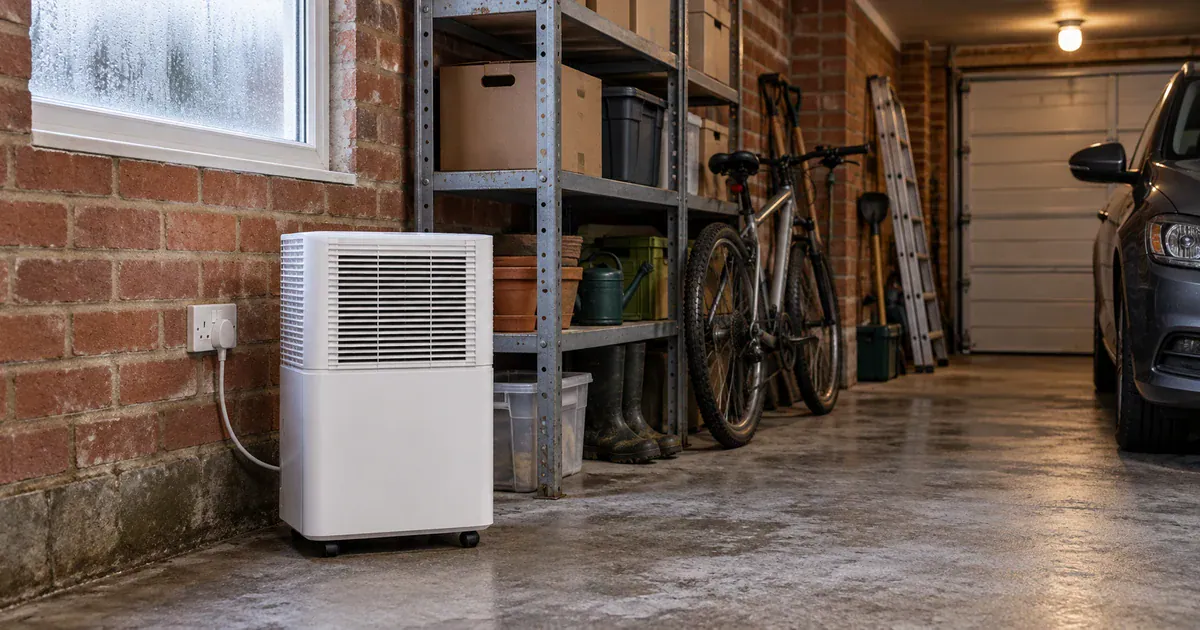
A garage is a cold concrete box. That is why your tools are rusting.
Rust on spanners that were fine in September, white mould on a leather bag, boxes gone soft at the bottom, a bike that squeaks all winter. None of that is bad luck. An unheated garage, shed or lock-up sits at outside temperature with a cold slab underneath, and every mild, wet day puts moisture into it that it cannot get rid of. Here is what is actually happening and what fixes it.
Why does a garage or shed get damp in winter, and what stops it?
Because it is unheated and uninsulated, with a concrete slab that stays cold for weeks. On a mild, wet day the outside air is warm and loaded with moisture; it comes in, meets cold metal, cold concrete and cold tools, and condenses on them. Add a wet car or wet garden kit brought inside and the space has no way to lose that water again.
What works is a combination: keep liquid water out, let the space breathe, get everything that matters off the floor and away from the walls, and dry the air. A dehumidifier is the part that does the last job, and in an unheated space it wants a little help from a low background heat and from a sensible set-up — which is the honest part most pages leave out.
Why it gets damp
Six causes, usually two or three of them at once in the same building.
Concrete holds the cold long after the air has warmed up, so the floor is the coldest surface in the building. Warm damp air meeting it condenses, which is why a garage floor can be wet with no leak anywhere.
The worst day for a garage is a mild, humid day in February. The building is still cold from the week before, the incoming air is full of moisture, and everything metal sweats.
A car brings in several litres of water on its panels and wheels on a rainy day, and a closed garage has nowhere to put it. The same goes for wet garden tools, wet kit bags and wet dogs.
Many garages have an airbrick or vent that is behind a stack of boxes, painted over, or blocked by a new fence or raised ground outside. A sealed box with a cold floor is a condensation machine.
Driveways that slope towards the garage, blocked gullies, a door with no threshold, or an up-and-over door with a gap underneath. This is liquid water, and no dehumidifier will out-run it.
Cardboard, paper, fabric, timber and bags of compost all hold moisture and release it back into the air. Damp storage keeps a damp building damp.
Sheds and timber workshops have the same problem with one addition: a timber building moves with moisture, so doors that stick in winter and loosen in summer are telling you the same story the rust is.
What it ruins first
Damp in a garage rarely announces itself. It shows up as a series of small losses that add up to more than a winter of hire. You can hire a dehumidifier in London from us in every size we stock.
| What is stored | First sign | What helps most |
|---|---|---|
| Hand and power tools | Orange bloom on bare steel, stiff moving parts | Dry air plus a closed toolbox with the lid down; wipe and oil before storing |
| Bikes and sports kit | Rusty chain and cassette, mildew on saddles and bags | Off the floor, away from the outside wall, dried off before they go in |
| Paperwork, photos and books | Soft, wavy paper and a musty smell | Sealed plastic boxes, raised on a shelf, never cardboard on concrete |
| Soft furnishings and clothing | Spots of mould, a smell that comes home with them | Do not store them in an unheated building unless the air is being dried |
| Paint, filler and adhesives | Tins rusting through, products ruined by freezing and damp | A shelf, not the floor, and the warmest corner of the building |
| Appliances and electronics | Corrosion on contacts and boards | Dry air; condensation inside electronics is what kills them, not cold |
| The car itself | Damp carpets, misted glass every morning, surface rust on brake discs | Ventilate, keep the slab dry, and do not seal a wet car into a cold box |
| The building | Mould on timber, rust marks on fixings, a musty smell that never clears | All of the above, plus keeping liquid water out at ground level |
If the smell has already got into stored fabric and boxes, our guide on where a damp smell actually comes from applies to a garage as much as a house. Visible growth on walls is covered in getting rid of black mould.
What actually works
In this order. The first three cost nothing, and they decide how much work the machine has to do.
1. Stop liquid water getting in
Check where water goes when it rains: a driveway falling towards the door, a blocked gully, a gap under an up-and-over door, a missing threshold, a gutter discharging against the wall. Water running in at ground level is a building job, not a drying job, and no dehumidifier will keep up with it.
2. Find the ventilation and unblock it
Most garages have at least one air vent or airbrick. Look for it behind the boxes, under the paint or outside behind a raised flower bed. A building that can exchange a little air with outside is far less prone to sweating than a sealed one.
3. Get everything off the floor and off the outside walls
Shelves, pallets, racking, anything. The floor and the north-facing wall are the coldest surfaces, and anything touching them collects condensation first. A 5 cm gap behind and under makes a visible difference.
4. Change what you store things in
Cardboard boxes on a concrete floor are the classic mistake: they wick, hold moisture and go mouldy from the bottom up. Sealed plastic boxes on a shelf solve half of a garage damp problem on their own.
5. Do not seal a wet car in
If the car goes in soaking, leave the door open for a while, or ventilate, or accept that the water has to go somewhere. Wiping the car down is not daft: it is a few litres you are not asking the building to deal with.
6. Dry the air, and give the machine a chance
Run a dehumidifier with the drain hose to a gully or a tub so it does not stop on a full tank, and set the humidistat around 55 to 60% rather than chasing 40% in an unheated space. A little background heat makes a refrigerant machine work far better, and that matters more here than anywhere else in the house.
7. Check it again after a mild, wet week
Mild and humid is the test, not cold and dry. If the floor stays dry and the metal stays clean through a week like that, the set-up is working.
One thing to avoid: sealing or painting a concrete garage floor and the walls in an attempt to lock moisture out. Trapping moisture in a cold structure usually just moves the problem, and in an outbuilding the cheaper answer is ventilation, storage discipline and dry air.
The honest bit: dehumidifiers in an unheated building
Every machine we hire is a refrigerant dehumidifier, and refrigerant machines lose capacity as the air gets colder. In a heated room they are excellent. In a garage at 5°C in January they still work, but they pull less water per day than the headline figure, and they will spend part of their time defrosting the coil rather than collecting.
What that means in practice:
We go into the physics in why a dehumidifier seems not to work in a cold room. The short version for a garage: a sealed, dry, slightly warmed building with a modest machine beats a freezing building with a big one. If a space genuinely cannot be warmed at all, a dehumidifier is a damage-limitation tool, not a cure, and the storage changes above do more of the work.
Which machine for a garage or shed
Most single garages, workshops and lock-ups are a compact machine job. The bigger machines earn their keep where the space is large, or where you are drying it out after water has actually got in.
Pick by the building:
Not sure which? Our sizing guide works from the space rather than the marketing figure, and we are happy to say on the phone that your garage does not need the big one.
What it costs
A garage job is usually a short hire to dry the building out and get the moisture out of what is stored, rather than a machine running all winter. Current London prices, before VAT:
| Machine | 1 day | 2 days | Up to a week | Longer hires |
|---|---|---|---|---|
| Compact 19 L | £19.99 | £24.99 | £34.99 | from £4.50 a day |
| 38 L dehumidifier | £29.99 | £44.99 | £59.99 | from £8.40 a day |
| Dri-Eaz Cube with pump | £39.99 | £59.99 | £74.99 | from £11.20 a day |
| High-airflow air mover | £15.49 | £23.49 | £29.99 | from £4.20 a day |
| 63 L LGR building dryer | £59.99 | £89.99 | £119.99 | from £16.80 a day |
Pick your dates on the product page and the exact total appears before you book. A refundable deposit and photo ID apply to every hire. Delivery and collection across London can be added at checkout, or collection from our Greenford depot is free. Running cost is the other half of the sum, and our guide to running costs works it out for your tariff — worth reading before leaving anything running in an outbuilding for weeks.
Garage and shed damp: common questions
Why is my garage floor wet when there is no leak?
Almost always condensation. The slab stays cold for weeks, and when mild humid air comes in it condenses on the coldest surface in the building, which is the floor. If the wet patch appears in mild weather rather than during rain, that is what is happening.
Will a dehumidifier work in an unheated garage?
It will work, but more slowly than in a heated room, and below about 5°C a refrigerant machine does very little. A small amount of background heat transforms what it can do. In a space that cannot be heated at all, treat the machine as damage limitation alongside better storage.
Should I ventilate the garage or seal it up?
Ventilate, within reason. A little air exchange stops a cold building sweating. Sealing an unheated garage tight and hoping for the best is how people end up with rust on everything. Keep liquid water out, let air move, and dry what is left.
Is it bad to store cardboard boxes in a garage?
Yes, particularly on the floor. Cardboard absorbs moisture from the slab and the air, holds it, grows mould and passes the smell on to everything inside it. Sealed plastic boxes on a shelf are the single cheapest improvement most garages can make.
Why do my tools rust even though the roof does not leak?
Because steel is a good conductor and sits at the temperature of the building. When warmer, wetter air arrives, the tools are the first thing it condenses on. Dry air, a closed toolbox and a wipe of oil on bare steel deal with it.
Can I store a fridge, washing machine or electronics out there?
You can, but condensation inside electronics and on contacts is what damages them, more than the cold itself. If it has to be stored, keep the air dry, raise it off the floor, and let it come up to temperature before switching it on.
My shed smells musty. Is that dangerous?
The smell itself is mould and bacteria growing on damp material. It is not something to live with in a building you use regularly, and anything soft that has been in there is better washed or aired than brought straight back into the house.
Do those tubs of moisture-absorbing crystals work?
They remove a token amount of water compared with what a garage takes on in a wet week. A small hired machine will usually take out more in an hour than a tub does in a month. Crystals are fine in a wardrobe, not in a building.
What humidity should I aim for in a garage?
Something around 55 to 60% relative humidity is a sensible target for an unheated store: dry enough to stop rust and mould, realistic enough that the machine is not fighting a losing battle. Houses are usually held lower, around 50 to 55%.
Can I hire for a weekend rather than a month?
Yes. Hires start at one day, and the rate drops for longer bookings. A lot of customers hire for a week or two to dry the building and everything in it out properly, then fix the storage and ventilation so it stays dry.
Related guides
More damp and drying guides:
Tell us about the building and we will tell you what to hire
Rough size, whether it is heated at all, whether the floor actually gets wet or just feels damp, and what you are trying to protect. We will tell you which machine, where to put it and what to expect in cold weather. If better storage and a cleared air vent would fix it without a hire, we will say that too.
Sources and limits: the temperature behaviour described here applies to refrigerant dehumidifiers, which is what our hire range consists of; capacity figures quoted by any manufacturer are measured in warm, humid test conditions and are not what a cold outbuilding will produce. The 40–60% relative humidity range for occupied buildings is from CIBSE TM40:2020, Health and Wellbeing in Building Services; the slightly higher target suggested for unheated stores is practical advice rather than a standard. Water entering a building at ground level is a building defect and needs fixing rather than drying. Hire prices are correct at the time of writing, exclude VAT, and the full price for your dates is shown at checkout.

 Drone Survey & Mapping
 Drone Inspections