
 Drone Services
 Access Equipment
 Breaking & Drilling
 Cleaning Equipment
 Drying & Heating
 General Site Tools
Drying & Heating, Equipment Hire Guides
Drying a Building Site in Winter: Heat, Kit and Costs
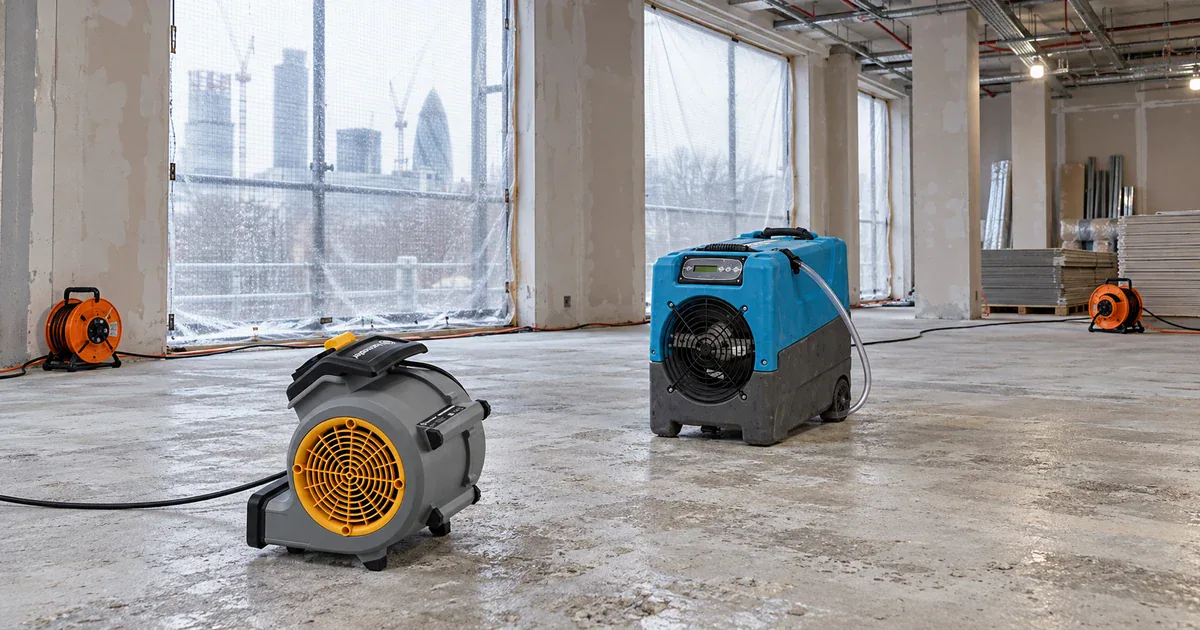
A winter site does not dry itself. It needs heat, extraction and moving air.
From November onwards the same programme that worked in July starts slipping. Plaster stays grey, screed will not hit the reading, paint goes on over damp and comes back off, and everyone blames the weather. The weather is only half of it: a closed, cold building with four wet trades in it has nowhere to put the water. This is how to get a London site drying again, in the right order, and what it costs to hire.
How do you dry a building site in winter?
Close the envelope, warm the building to a steady working temperature, run dehumidifiers continuously to take the moisture out of that warmed air, and put air movers across the wet surfaces so they keep releasing it. In that order. Heat on its own raises the temperature and the humidity together and dries very little; ventilation on its own, in a London January, swaps your damp air for outdoor air that is nearly as wet.
The machines that do it are a building dryer rather than a domestic dehumidifier — a 63 L low grain refrigerant unit or a 95 L for larger floor plates — plus electric heat and two or more air movers. What you should not do is run direct-fired gas or diesel heaters in a closed space: burning fuel releases water vapour, so you add moisture to the building you are trying to dry, along with the ventilation and safety requirements that come with combustion.
Why winter sites stall
Nothing on this list is news to anyone who has run a site in January. It is worth setting out anyway, because the fix follows directly from the cause. For prices and sizes, see our dehumidifier rental in London page.
| Cause | What it does | What changes it |
|---|---|---|
| Cold slab and cold structure | Materials hold their moisture and give it up slowly; surfaces sit below the dew point of the air around them | Steady background heat, held rather than switched on and off |
| Humid outside air | In a British winter the outside air is often as wet as the inside; opening up achieves nothing | Close the building and dehumidify rather than ventilate |
| Several wet trades at once | Screed, plaster, render and paint all put litres into the same air | Sequence the work, and size the drying for everything that is wet |
| No heating system yet | Permanent heating is one of the last things commissioned, exactly when drying matters most | Temporary electric heat sized to the space and the supply |
| An open envelope | Missing glazing, open risers and uncovered openings leak the conditions you are paying for | Sheet the openings before the machines go in, not after |
| Short days and long weekends | Machines switched off on a Friday give the building three days to even out again | Leave the kit running; that is what the long-hire rate is for |
The result is the same every year: trades turn up, cannot start, and the programme absorbs it. Drying equipment is cheap against two days of a plastering gang standing down.
The order that works
Six steps. Doing them out of order is the single most common reason a site hires drying kit and still misses the date.
1. Close the envelope first
Glazing in or openings sheeted, external doors on or boarded, risers and lift shafts closed off. Every open hole is conditioned air leaving and outside air arriving. This costs almost nothing compared with the equipment and it decides how well the equipment performs.
2. Get the building to a working temperature
Steady background heat, not a blast. Warm materials release moisture; warm air can hold more of it so the dehumidifier has something to take. Size the heat to the volume and, just as important, to the electrical supply you actually have on site.
3. Put the dehumidifiers in and leave them running
Building dryers, not domestic units, and running continuously including nights and weekends. Use the drain hose or pump-out to a gully — on a wet floor plate a tank fills faster than anyone will empty it.
4. Add air movers where the water is
Low level, aimed across the slab or along the wall rather than straight at it. Air movers are what stop a wet surface sitting under its own damp layer. On a big floor, several spread out beat one powerful fan in a corner.
5. Measure, do not guess
A cheap hygrometer in each zone tells you whether the conditions are actually improving. For floors, the reading that matters before flooring is the surface hygrometer test on the slab — our screed drying guide covers the method and the usual 75% limit.
6. Sequence the wet trades
Screed, plaster and render in the same week, with the same drying kit, is three jobs fighting each other. Stagger them where the programme allows, and keep the kit on site between them rather than off-hiring and re-hiring.
Heat: what to hire, and what not to
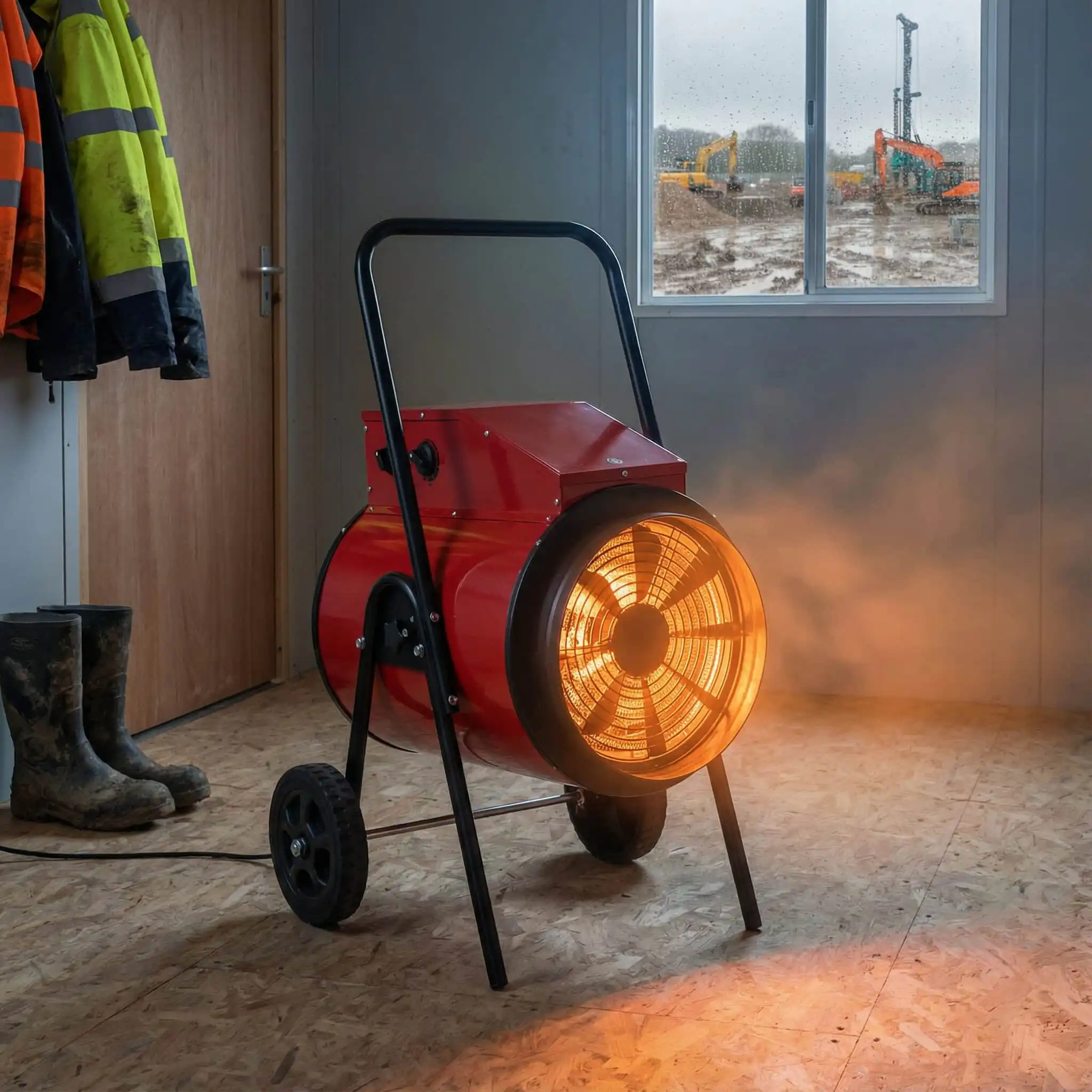
Electric heat is the straightforward answer on a London site: no combustion products, no fuel storage, no ventilation requirement beyond the normal. The constraint is the supply, so pick by what the site can actually feed.
| Heater | Supply | Suits |
|---|---|---|
| 3 kW 110 V fan heater | 110 V 32 A site transformer | Standard site supply, single rooms and small areas; the usual choice on a CDM site |
| 3 kW fan heater, 240 V | Standard 13 A socket or site 240 V | Fit-out work, flats, occupied buildings and refurbishments |
| 3 kW infrared heater on a tripod | 240 V | Warming surfaces and working areas rather than the whole air volume |
| 3 kW oil filled radiator | 240 V | Quiet background heat where a fan is intrusive |
| 9 kW industrial fan heater | Three phase | A floor of a building, a unit or a large open space |
| 15 kW industrial fan heater | Three phase | Larger floor plates and commercial units |
| 40 kW industrial fan heater | Three phase | Warehouse-scale volumes |
What to avoid: direct-fired gas or diesel heaters inside a closed building. Burning a litre of fuel releases a comparable amount of water into the air, so the machine fights the dehumidifiers you are paying for, and combustion in an enclosed space brings carbon monoxide and ventilation requirements with it. If fuel-fired heat is unavoidable, it should be indirect, with the combustion products flued outside. Our comparison of heaters versus dehumidifiers goes into why heat alone rarely dries anything.
Dehumidifiers and air movers for a site
Two things separate a building dryer from the machine someone brings from home. The first is capacity: a site has a far larger volume of air and far more wet material. The second is low grain refrigerant, which keeps pulling moisture down at temperatures and humidity levels where a standard machine stops being useful.
Pick by the space you are drying:
Prefer one booking? The drying packages pair the machines: the LGR flood package and the heavy duty 95 L package are the two site-sized options.
How many? As a rough planning rule, one building dryer per open floor area with two or more air movers on the wet surfaces, then adjust after the first week based on what the hygrometer is telling you. Our guide to how many machines goes into it properly, and we are happy to work it out with you over the phone against a floor plan.
What it costs
Site drying is a weeks-long hire, so the long-hire daily rate is the number that matters on a programme. Current London prices, before VAT:
| Equipment | 1 day | 2 days | Up to a week | Longer hires |
|---|---|---|---|---|
| 95 L building dryer | £77.99 | £111.99 | £149.99 | from £19.99 a day |
| 63 L LGR dehumidifier | £59.99 | £89.99 | £119.99 | from £16.80 a day |
| High-airflow air mover | £15.49 | £23.49 | £29.99 | from £4.20 a day |
| 110 V 3 kW site fan heater | £19.99 | £29.99 | £39.99 | from £5.60 a day |
| 9 kW three-phase heater | £24.99 | £39.99 | £49.99 | from £6.99 a day |
| 15 kW three-phase heater | £29.99 | £44.99 | £59.99 | from £8.40 a day |
Trade accounts get 15% off every hire, and we invoice rather than taking card each time. Pick your dates on the product page and the exact total appears before you book; a refundable deposit and photo ID apply. Delivery and collection across London can be added at checkout, or collect from our Greenford UB6 depot. Electricity is the other line in the budget and our running cost guide works it out properly — on a long hire with heaters running, it is not a rounding error.
Winter site drying: common questions
Is it cheaper to just wait for better weather?
Rarely, on a live programme. A trade standing down for two days, or a floor finish that has to be lifted and relaid, costs more than several weeks of hire. Waiting also means waiting until spring: a cold building in a London January does not dry much on its own.
Heater or dehumidifier — which comes first?
Both, together, in that order. Heat makes the materials give moisture up and lets the air hold it; the dehumidifier takes it out of the building. Heat alone just produces warm, damp air and condensation on every cold surface. The detail is in our heater and dehumidifier comparison.
Should the building be ventilated or sealed?
Sealed, in winter, once you are running drying equipment. Ventilation is a summer strategy, when the outside air is genuinely drier than the inside. In December, opening up usually swaps your conditioned air for air that is nearly as wet.
Can I use gas or diesel heaters?
Not direct-fired inside a closed building. Burning fuel releases water vapour into the space, so you are adding moisture while trying to remove it, and combustion in an enclosed space brings carbon monoxide risk and ventilation requirements. Indirect heat, flued outside, is the exception.
How long will the building take to dry?
It depends on what is wet, how thick it is, the temperature you are holding and how much equipment is running — which is why we do not quote guaranteed drying times. The honest approach on a programme is to measure weekly and adjust the kit rather than to pick a date and hope.
Do I need LGR, or will a standard dehumidifier do?
In a heated, finished building a standard machine is fine. On a cold shell or a part-finished site, low grain refrigerant is what keeps working as the temperature and humidity drop. That is the difference between a machine that fills a tank and one that runs all week for very little.
How many machines for a floor plate?
As a planning figure, one building dryer per open floor area plus two or more air movers on the wet surfaces, then adjust after the first week. Send us the floor plan and we will give you a straight answer rather than a quote for everything we own.
Can you deliver to site, and do you invoice?
Yes to both. We deliver and collect across London from our Greenford UB6 depot, and trade accounts are invoiced with 15% off every hire. Tell us the site postcode, access and the dates.
What about the screed and the flooring date?
That is its own problem and it is usually the critical one. The flooring goes down against a hygrometer reading, not a calendar date — the screed guide covers the 75% relative humidity test and how drying equipment moves it.
Is the equipment site-safe?
The 110 V heaters run from a standard site transformer, and everything is PAT tested and checked between hires. We are a CHAS-verified supplier. If you need specific documentation for the site file, ask and we will send it with the hire.
Related guides
More trade guides:
Send us the floor plan and the programme
Tell us the floor area, what is wet, what the supply is on site and when the next trade is due. We will tell you how many machines, what heat the supply will take, and what it costs for the weeks you actually need it. Trade accounts get 15% off and an invoice rather than a card payment every time.
Scope and limits: this guide covers temporary drying and heating equipment on construction and refurbishment sites. It is not electrical, structural or CDM advice: temporary supplies, three-phase connections and site electrical safety are the responsibility of a competent person, and all equipment must be used in line with the site rules and the manufacturer instructions. Direct-fired combustion heating inside enclosed spaces carries carbon monoxide and moisture risks and is not recommended for drying. No drying time is guaranteed: it depends on what is wet, how thick it is, the temperature held and the equipment running. Hire prices are correct at the time of writing, exclude VAT, and the full price for your dates is shown at checkout.

 Drone Survey & Mapping
 Drone Inspections